
Our Mission
Joining a movement that brings people together, spreading love and joy, as well as promotes the health of the planet for generations to come. We see the beauty in the potential and will share that with others.
Meet the Team
The friendly and furry faces behind the flowers

Owner
Maggie Skitt
Maggie created HHFF with the idea of bringing sustainability to flowers. With a love the environment and animals, she saw an opportunity to combine being kind to the planet while sharing her passion for flowers with others. Balancing her full-time job and starting this farm is no easy feat, but her mom makes everything easier!

Helping Hands
Stephen Cameron
Stephen may not have a background or passion for flowers, but he still helps out with a smile on his face and something sarcastic to say! His fun-loving energy brings the team together with good spirit. As a teenager he had an eye-opening experience growing vegetables. Cucumbers were his personal favorite to grow because he was able to turn them into pickles, his absolute favorite food!

Helping Hands
Kerry Skitt
Kerry is the backbone of this operation. She helps brainstorm and assists with every action we take, from yard work and seed starting to ensuring the tiny seeds grow. Most importantly, she uses her 30+ years of floral design experience to create magic with our blooms. Kerry loves spending her free time playing with her grandchildren and going on car rides with a Dunkin iced coffee in hand and Maggie by her side. She also enjoys doing brain puzzles.

Sustainability Team
Lola & Pepper
We're the butts and buns behind the operation! Constantly supplying new compost, munching and pooping daily. We love begging for treats; we get so protective that we'll snatch it out of your hands and hop in a corner by ourselves to eat it. We also love running around and finding new secret spots we can wreak havoc in.



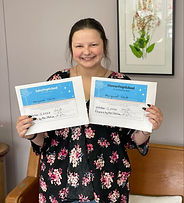
How Her Hands Flower Farm came to be
My name is Margaret Skitt, Maggie for short. I’m born and raised in Attleboro, MA. I want to be a flower farmer - florist. I previously worked part-time at local flower shop. I worked there from Feb 2021 - March 2024. While there I was a junior floral designer, learning sympathy work, and storefront retail employee. The owner, my boss at the time, frequently did one on one meetings with every employee to see how to better support us as well as help us expand our interests. I’ve always had a passion for nature, animals and the environment as a whole. I wanted to learn about sustainability. At the time I was also a part time student at Bristol Community College (BCC), which had just recently gotten rid of the sustainability major. But there were still a few classes that I could take that would allow me to get credits towards my degree of Social and Behavioral Sciences, a major I didn’t want but I was told would give me more opportunity to transfer in the future. I signed up for a sustainability class, which would then not run because it didn’t have enough enrollments. I was then put into a class that was farming based. I was admittedly not interested in the idea of this class… The class was SOC 216: ‘Food, Famine, and Farming in the Global Village.’ Which in my head, was very different from sustainability. I needed the credit and the professor convinced me it would be similar enough. Prior to this class I had no idea there were so many different methods and types of farming. The class emphasized the importance of soil health, something I knew absolutely nothing about, and I still have a lot to learn about. The importance of shade and plants was also emphasized, as concrete jungles are a major danger to the health of the planet. In addition we learned about how negatively impacted rural communities and inner cities are by lack of food sources. Both healthy foods and programs to help families afford healthy foods. In the end, that class ended up being one of the most impactful classes I’ve ever taken. Now what does all of this have to do with flower farming? While taking that class, I began to think about how the topics I was learning could be applied to the floral industry. Most flowers are coming in from other countries and are COVERED in chemicals. When the shop got in more stock it needed to be processed. Stripped of leaves, cut and put in water. Other flowers require additional steps, but that's the gist of it. My hands always felt so dirty after touching all these flowers, and it occurred to me one day that it was from the chemicals! Then of course buying produce from local farmers was a major theme in the class. All these thoughts and ideas kept swirling around in my brain until it hit me! Which was not a unique thought and is actually concerning that I never had these questions and thoughts prior. One of the biggest ways to bring sustainability to the floral industry and by resourcing the flowers locally! Again, why did I not realize or think about this sooner? Nonetheless, it was perfect. Not only is this supporting local farmers and small businesses, but it's also supporting practices that are environmentally safe. I want to be a flower farmer - florist so I can empower myself and others; spread joy and love through flowers; promote and practice sustainability by aiding soil health, adding more plants to this planet, and giving more opportunity to source flowers without the use of chemicals. Flowers are important pieces to many life stages. When a baby is born, a mother sometimes receives them. Flowers are given as gifts for birthdays and holidays such as Mother’s Day. Some people display flowers as centerpieces for family gatherings, such as Thanksgiving and Christmas. People give flowers when they are in love, celebrating, and just because. Flowers are oftentimes a big part of weddings, one of the biggest life events to have and attend for someone else. They’re also there for you to brighten your darkest days. Bereaving people and families receive flowers, as well as to send off their passed loved ones into their afterlife.